
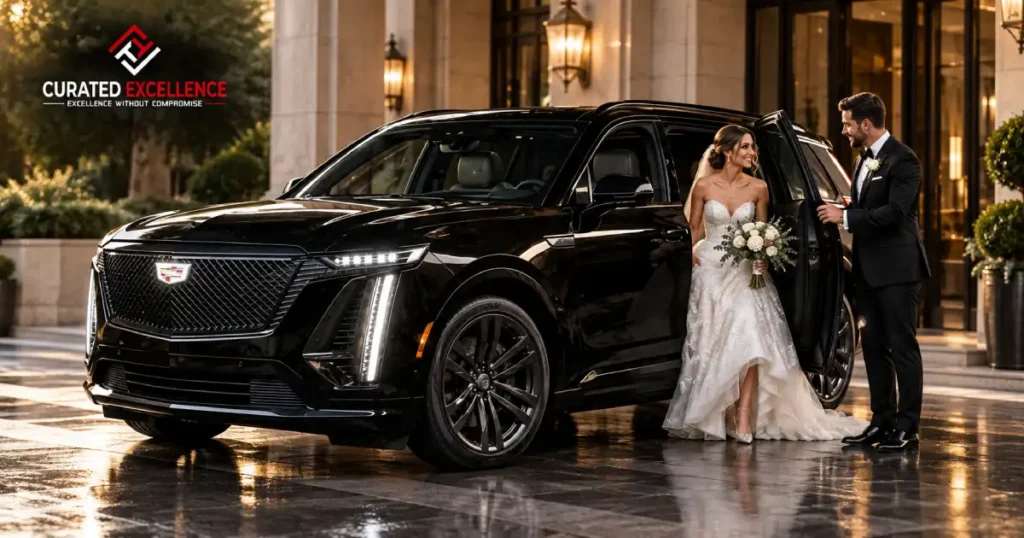
For wedding car timing Chicago couples can use 60-90 minutes as a practical starting point when the same luxury vehicle is needed for portraits and a coordinated arrival. Allow more time for a separate photo location, large wedding party, downtown traffic, complex venue access, or a second staging window.
The right duration comes from the plan, not from the car alone. A vehicle used for a short portrait session at one venue needs a very different schedule from one that must be staged for couple photos, repositioned for the wedding party, then presented again for the arrival.
Curated Excellence’s wedding-focused vehicle experience is built around photo-ready staging, grand-arrival planning, and coordinated presentation rather than treating every booking as the same type of transportation.
Key Takeaways
- Use 60-90 minutes as a practical starting point for one photo session plus a coordinated arrival.
- A simple one-location portrait setup may need less time if the vehicle is already staged.
- Add time whenever the car must move between a photo location and the venue.
- Group photos take longer because people must be gathered and arranged.
- Downtown Chicago traffic, valet activity, and venue access can consume time that is not visible in the photo schedule.
- Golden-hour portraits and a later exit may work better as two separate vehicle windows.
- Confirm whether the vehicle is for presentation, photos, arrival, or transportation before building the timeline.
Start With the Vehicle’s Role
Start by defining exactly what the vehicle is doing.
Is it there only for couple portraits? Will it appear in wedding-party photos? Does it need to be staged at the ceremony entrance? Is it part of the reception arrival or grand exit? Will it move between locations?
If you are still deciding how the vehicle fits the day, the guide to choosing a luxury car for a Chicago wedding arrival explains how vehicle choice, venue style, photography, and arrival presentation work together.
It is also important to separate a staged wedding vehicle experience from ordinary transportation. The wedding car display vs wedding transportation comparison explains why a photo-ready display or arrival moment may need a different timeline from a point-to-point ride.
Wedding Car Timing Chicago: Practical Time Windows
These are planning ranges, not fixed package lengths. Use them to build the first version of the timeline, then adjust for the actual venue, photographer, vehicle, and locations.
| Wedding Plan | Practical Starting Window | What the Time Covers |
| Couple portraits at one venue | 30-45 minutes | Positioning, portraits, detail shots |
| Couple + wedding-party photos | 45-60 minutes | Staging, portraits, group organization |
| Photos + coordinated arrival | 60-90 minutes | Photos, repositioning, arrival buffer |
| Separate photo location + venue arrival | 90-120 minutes | Travel, staging at both locations, photos |
| Golden hour + later exit | Two windows | Sunset portraits and separate exit staging |
The goal is not to reserve the longest possible block. It is to protect the moments you want photographed without turning the wedding day into one long vehicle session.
When 45-60 Minutes Can Work
A 45-60-minute window can work when the vehicle stays at one location and the photo plan is focused.
For example, the car may already be staged outside a hotel or venue. The photographer captures couple portraits, a few wedding-party combinations, vehicle details, and a final arrival-style frame.
This works best when everyone is nearby and the photographer already knows the planned angles.
Remember that part of the hour may be used for positioning, an exterior check, and gathering people. If twenty minutes disappear because the wedding party is still inside, the photography window becomes much smaller.
When 60-90 Minutes Makes More Sense
For photos plus a coordinated arrival, 60-90 minutes gives the schedule more breathing room.
A practical example could look like this:
- 10-15 minutes: vehicle arrival and final positioning.
- 20-30 minutes: couple portraits.
- 10-15 minutes: wedding-party or family photos.
- 5-10 minutes: repositioning for the arrival.
- 10-15 minutes: buffer before the main entrance moment.
This is an example planning framework rather than a fixed Curated Excellence schedule. The actual timing should be built around the photographer, venue, and wedding timeline.
A buffer matters because hair and makeup can run late, family photos can stretch, and valet traffic can temporarily block an entrance.
Without that breathing room, one small delay can turn the most important vehicle moment into the most rushed part of the day.
When You Need 90-120 Minutes
More time becomes useful when the vehicle needs to move between locations.
A separate portrait stop adds more than driving time. The car may need to leave one staging area, reach the next location, find the approved position, wait for the couple or photographer, then move again for the venue arrival.
If the plan includes several Chicago backdrops, one calm photo location plus the final venue often creates a better experience than squeezing three or four stops into the same period.
More locations do not automatically mean better wedding photos.
Plan the Arrival Backward
For a grand arrival, start with the exact moment the couple should appear and work backward.
If the arrival is planned for 5:30 p.m., the vehicle should not reach the property at 5:30. It may still need to clear valet traffic, enter the correct driveway, move into position, and be checked before the photographer and couple are ready.
A useful sequence is:
Arrival moment → final staging → photographer ready → vehicle positioned → venue access → travel buffer.
That structure gives every person involved a clear deadline.
It is much more reliable than simply choosing a departure time and hoping the venue entrance is clear when the car gets there.
Build in Chicago Traffic and Venue Access
In Chicago, the route is only one part of the timing.
Downtown hotels may have active valet lanes. Event spaces can have separate loading entrances. Street activity can change access, while private venues may limit how long a vehicle can remain near the main entrance.
The photo location can add another layer.
The Chicago Park District currently requires permits for wedding and other special-occasion photography on Park District property. It also identifies several independently managed locations that use separate procedures.
That makes early location planning important.
Photography permission should also not be treated as automatic permission to stage a vehicle in the same spot. Confirm vehicle access separately with the venue or location manager.
Consider Golden Hour Separately
If softer sunset portraits are a priority, the best photo time may not match the arrival time.
For example, the couple may arrive before sunset, enter the reception, then step outside later for a short portrait session with the vehicle.
In that situation, a second short staging window may work better than stretching the earlier arrival schedule.
Adobe’s guidance describes golden hour as softer, lower-angle and more directional than midday light, which helps explain why photographers often reserve a short evening window for portraits.
For Ferrari-specific wedding photography, the Ferrari wedding photo timing and staging guide covers how timing, background, and positioning affect the finished images.
A well-planned short session can add variety without turning the evening into another full photo shoot.
Do You Need Extra Time for Group Photos?
Usually, yes.
The challenge with group photos is often not taking the picture. It is getting everyone together.
Decide beforehand who actually needs to appear with the vehicle.
The most useful combinations might be the couple alone, the wedding party, immediate family, and one wider venue photograph.
The car does not need to appear in every formal portrait.
Keeping the vehicle shot list focused gives the photographer more time to create stronger compositions and keeps the wedding party from spending too long outside the event.
Should the Vehicle Stay for the Whole Reception?
Not necessarily.
If the vehicle is mainly needed for portraits and the arrival, there may be little value in keeping it staged through the entire reception.
A later grand exit changes the calculation.
If both an early arrival and a late departure are important, ask whether the plan should use one longer window or two separate presentation periods.
Do not assume the vehicle automatically stays onsite all evening. Confirm the exact schedule and service boundaries before building other parts of the wedding around it.
Wedding Vehicle Timing Checklist
Before finalizing the schedule, confirm:
- Vehicle role: portraits, arrival, exit, or a combination.
- Photo location: same venue or separate destination.
- People: couple only, family, or wedding party.
- Photographer window: when the photographer actually needs the car.
- Travel: realistic route plus loading and access time.
- Staging: where the vehicle waits and where it appears for photos.
- Golden hour: whether sunset portraits need a separate window.
- Weather backup: covered or indoor alternative if needed.
- Final event moment: exact arrival or exit time.
Curated Excellence’s luxury vehicle experience packages in Chicago include photo-focused and grand-arrival options, which makes it easier to plan the vehicle around the wedding moment rather than treating every event the same way.
Frequently Asked Questions
Q1: Is one hour enough for wedding car photos?
One hour can be enough when the vehicle is staged at one location and the shot list is focused. It becomes tighter when the plan includes a large wedding party, another location, downtown travel, or a coordinated arrival.
Q2: How long should we allow for photos and an arrival?
Use 60-90 minutes as a practical starting point when the same vehicle is needed for portraits and a staged arrival. Add more time if the photographer and vehicle need to move between locations.
Q3: Should the vehicle arrive before the photographer needs it?
Yes. Build in enough time for positioning, a quick exterior check, and venue coordination before the couple begins the planned vehicle photos.
Q4: How much extra time does a second photo location add?
There is no universal number. Add the real travel time plus loading, staging, and time to gather the couple or wedding party again. In busy Chicago areas, access can matter as much as distance.
Q5: Should we keep the car for the whole reception?
Not automatically. If the vehicle is only needed for portraits, arrival, or exit, focused time windows may be more practical than keeping it onsite for the entire event.
How Much Time Should You Plan?
For wedding car timing Chicago couples can start with 45-60 minutes for a focused one-location photo session and 60-90 minutes for photos plus a coordinated arrival.
Separate locations, larger groups, downtown access, golden-hour portraits, or multiple staging moments can justify a longer window.
The strongest schedule is not the longest one. It is the one that protects the main photo and arrival moments while leaving enough flexibility for the rest of the wedding day.
Planning a Chicago wedding with a luxury vehicle? Curated Excellence can help coordinate the vehicle, photo window, venue timing, and arrival presentation around your wedding-day plan.