
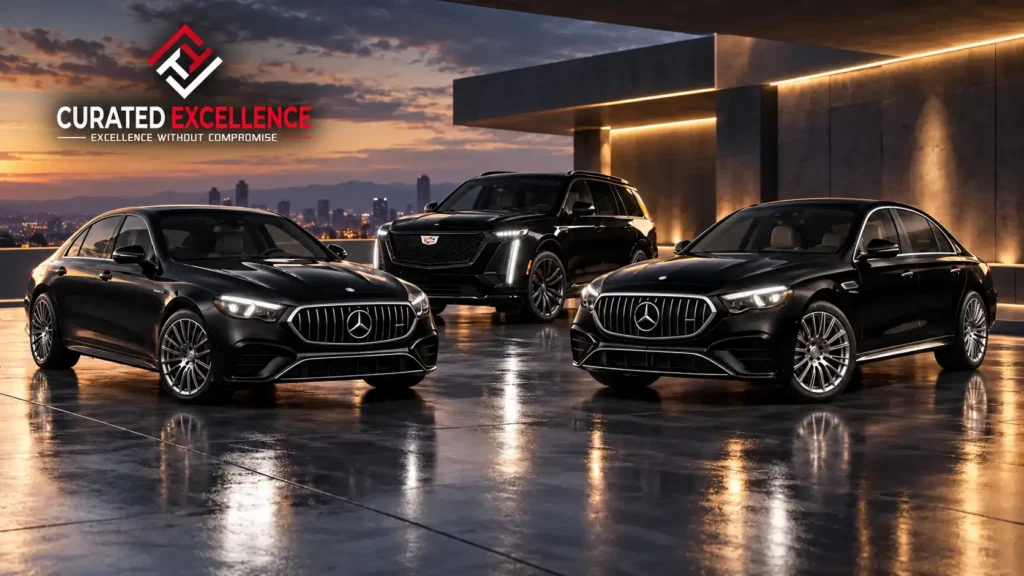
Black car photoshoot tips start with one idea: you are photographing reflections as much as paint. Use soft directional light, place the car against a background with clear tonal separation, control what appears across glossy panels, and expose carefully enough to keep the body lines visible without turning black paint grey.
Black luxury cars can look effortless in person and surprisingly difficult on camera. The clearcoat is highly reflective, so the camera sees a mix of bodywork, sky, buildings, pavement, people and light sources.
That matters even more for Curated Excellence because the Black Label fleet is all black. A consistent visual approach makes the collection feel intentional; uncontrolled reflections can make the same vehicles look flat or cluttered. The current Black Label luxury vehicle collection in Chicago also gives photographers several different body shapes to solve with the same visual system.
For permits, timing and production logistics, the exotic car photoshoot planning guide in Chicago covers the broader shoot plan. This guide stays focused on lighting, reflections and backgrounds.
Key Takeaways
- Shape black paint with reflections instead of trying to remove every reflection.
- Use soft directional light, open shade or lower-angle light when possible.
- Give the vehicle enough background contrast to preserve its silhouette.
- Check glossy panels for people, poles, signs, windows and other cars.
- Use a circular polarizer selectively; useful highlights should remain.
- Keep exposure controlled so black stays black while body lines remain visible.
- Clean the vehicle immediately before hero shots.
- Use the same reflection checklist across the whole fleet.
Why Black Luxury Cars Are Harder to Photograph
A glossy black car behaves like a curved dark mirror. If the scene has too little tonal variation, the doors, hood and roof can blend together. If the surroundings are too busy, the paint fills with broken reflections that compete with the vehicle.
Adobe’s automotive photography guidance recommends choosing a background that contrasts with the vehicle and notes that darker cars can work well against brighter backgrounds. It also recommends golden-hour light or shade to reduce the glare and hard shadows caused by direct midday sun.
Black Car Photoshoot Tips: Control the Reflections First
Before taking the hero shot, walk around the vehicle and look at the paint without the camera.
What appears in the hood? Is a bright window cutting through the door? Can you see yourself, a light stand or another parked car?
Then move.
A small change in camera position can remove a pole from a door. Rotating the vehicle a few degrees can turn a messy reflection into a clean gradient. Pulling the car forward can make the hood reflect open sky instead of a dark overhang.
The best reflections are usually simple. Bright sky can create a smooth highlight across the shoulder line, while a darker building creates the shadow band beneath it. Together, those tones reveal shape.
Choose the Light That Shows the Body Lines
Golden hour is useful because lower-angle light creates longer, softer gradients than overhead midday sun. It can also flatter a couple, model or executive when people share the frame.
Open shade is often even more practical. Place the car in the shade of a building while keeping it exposed to open sky. The building blocks direct sun while the sky becomes a broad natural source reflected in the paint.
Overcast conditions can work well too, but completely flat light may reduce dimension. If that happens, reposition the car so one side reflects brighter sky and another picks up a darker structure.
If midday is unavoidable, look for one broad area of shade rather than letting half the car sit in direct sun and half in deep shadow.
Use a Circular Polarizer Selectively
A circular polarizing filter can reduce glare and some reflections from glass, clearcoat and other non-metallic surfaces. B&H’s current polarizer guide explains that the effect changes as the filter is rotated and depends on the angle of the reflected light.
A setting that cleans the windshield may also remove a highlight that was defining the door. Rotate the filter for each composition and decide how much reflection you actually want to keep.
The goal is controlled reflection, not zero reflection.
Pick a Background That Separates the Car
Black on black can look dramatic, but only when lighting creates a clear edge.
For an easier setup, choose a background that is lighter or tonally different from the vehicle: pale stone, light concrete, open sky, softly lit architecture or a clean neutral wall.
In Chicago, glass and stone architecture can create beautiful reflection lines across black paint. They can also become a problem if every window grid, sign and passing person appears in the bodywork.
One of the most useful black car photoshoot tips is to watch the ground as carefully as the wall behind the vehicle. Bright concrete can bounce pale reflections into the lower doors, grass can add green contamination, and wet pavement can create a deliberate mirrored effect.
For branded content, the guide to choosing a luxury vehicle for a brand photoshoot is useful when the bigger decision is which vehicle fits the campaign rather than how to light it.
Expose for Detail Without Turning Black Paint Grey
A frame dominated by dark tones can tempt the camera to brighten the scene. The result may be a black car that looks charcoal grey.
Do not chase detail everywhere.
Preserve deep blacks, then use highlights and reflections to reveal the body lines that matter. Watch the histogram and highlight warnings so bright reflections on glass and hood edges do not clip.
The photograph should still feel like a black car, not a grey car with every shadow lifted.
Pick Angles Based on the Highlights
A front three-quarter view works well because it shows the face and side of the car together. With black paint, however, the strongest angle is the one where the reflections explain the shape.
Move left or right while watching the side panel. Look for the point where the hood, fender, door and rear quarter each show slightly different tones.
For event-specific Ferrari work, the Ferrari wedding photos in Chicago guide shows how timing and backdrop choices affect the finished gallery. For the taller and more restrained AMG shapes, the Mercedes-AMG GLE 63 vs E53 event comparison helps explain how each silhouette fits different visual situations.
When People Are in the Frame, Light Them Separately
At weddings, proposals and brand shoots, the vehicle is often not the only subject.
If the car looks good but the person’s face is too dark, do not flood the entire scene with hard light. Use a reflector, soft LED, diffused flash or small position change to lift the person while preserving the reflection pattern on the car.
A black suit beside a black vehicle can lose separation quickly, so background tone, rim light and subject placement matter.
Clean the Car Before the Hero Frames
Black paint exposes dust, fingerprints, water spots and dried rain quickly. Adobe recommends keeping cleaning cloths and detailing supplies available during automotive shoots because even small vehicle movements can add dust or dirt.
Before the main frames, check the hood, mirrors, door handles, glass, wheels and any panel carrying a strong highlight.
Edit the Paint Without Destroying the Finish
Start with overall exposure and white balance, then use local masks where a body line needs extra separation.
Be careful with global shadow recovery, heavy clarity and aggressive texture. Those adjustments can make black paint look grey or artificial.
Black bodywork also picks up environmental color. Correct distracting casts without making every reflection unnaturally neutral.
All-Black Fleet Reflection Checklist
| Area | What to Check | Quick Fix |
| Hood | Blown sky, photographer, harsh hotspot | Change camera height or rotate car |
| Windshield | Excess glare | Adjust CPL or camera angle |
| Doors | People, poles, signs, light stands | Clear area or move viewpoint |
| Rear quarter | Broken building reflections | Rotate vehicle slightly |
| Roofline | Disappears into dark background | Add separation or edge light |
| Wheels | Dust, poor wheel angle | Clean and reposition |
| Lower panels | Pavement or grass color cast | Change position or correct locally |
| Background | Cars, bins, poles, signage | Reframe or move vehicle |
| People | Dark clothing merges with car | Add soft fill or separation |
| Overall paint | Black looks grey or too flat | Rebalance exposure and reflections |
This checklist can become a repeatable visual standard across Curated Excellence’s all-black fleet.
Frequently Asked Questions
Q1: What is the best lighting for a black luxury car?
Soft directional light is a strong starting point. Golden hour, open shade and controlled overcast light can reveal body lines without the harsh hotspots common in direct midday sun.
Q2: Should I use a polarizer when photographing a black car?
A circular polarizer can reduce glare and some reflections, but its effect depends on angle. Rotate it for each composition and keep enough reflection to preserve the car’s shape.
Q3: What background works best behind a black car?
Choose a clean background with enough tonal separation from the vehicle. Light stone, concrete, open sky and restrained architecture often work well.
Q4: Why does my black car look grey in photos?
The exposure may be too bright or the shadows may have been lifted too aggressively. Keep deep tones dark and reveal shape through controlled highlights.
Q5: How do I remove myself from the reflection?
Change position first. Step farther back, alter camera height or rotate the vehicle slightly. A small angle change often moves the photographer’s reflection away from the important panel.
Make the Reflections Describe the Car
The most reliable black car photoshoot tips come back to one principle: the best black luxury-car photos are not reflection-free. They use reflections deliberately.
Give the vehicle manageable light, enough background contrast to preserve the silhouette, clean highlight lines that reveal the bodywork, and an exposure that keeps black paint genuinely black.
Move the car or camera before reaching for retouching. Use a polarizer selectively. Keep the environment simple. Then apply the same reflection check across every shoot so the fleet looks consistent across weddings, campaigns and event content. Curated Excellence’s luxury car event services in Chicago support photo-focused vehicle presentation within its wider event model.
Ready to create standout content with a black luxury vehicle in Chicago? Curated Excellence can help plan a photo-ready vehicle experience around your concept, location, and visual goals.