
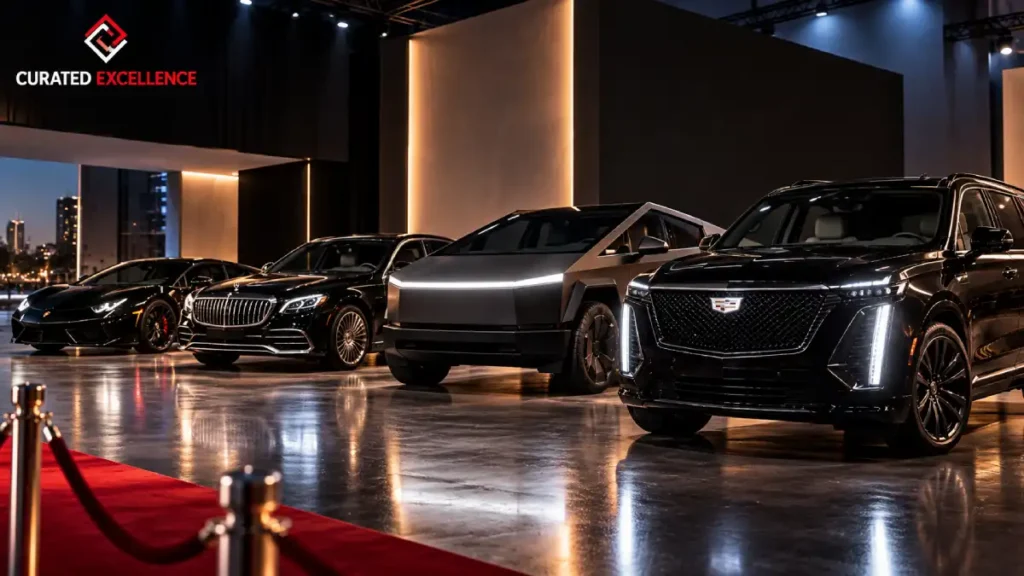
A multi-vehicle car display Chicago showcase is staged by planning the footprint, vehicle order, arrival sequence, camera angles, guest flow, and final lineup before the cars reach the venue. The strongest setups treat multiple vehicles as one coordinated visual composition rather than parking several luxury cars side by side.
A single luxury vehicle can create a focal point. Put two, three, or more distinctive vehicles together and the planning changes completely.
Now you have to think about how every car relates to the others, which model guests see first, where people will stand for photos, whether one vehicle blocks another, how the cars enter the space, and how the lineup will look in both wide and close-up content.
Curated Excellence currently offers a Multi-Vehicle Showcase built around two or more Black Label vehicles, high-impact staging, and custom lineup and placement.
What Is a Multi-Vehicle Showcase?
A multi-vehicle showcase uses two or more luxury or distinctive vehicles as one coordinated event installation.
It might be used for a corporate event, product launch, wedding, campaign production, brand activation, VIP event, or large photo shoot.
The important part is coordination.
If three vehicles arrive and are simply parked in the nearest available spaces, you technically have three cars-but not necessarily a showcase.
Curated Excellence currently lists Ferrari 488 GTB, Cadillac Escalade IQ Sport, Tesla Cybertruck, Mercedes-AMG GLE 63 Coupe, and Mercedes-AMG E 53 within its Black Label Collection, giving a multi-car setup several very different visual personalities to work with.
Start With the Purpose of the Showcase
Before deciding which vehicles to use, decide what the lineup needs to accomplish.
- A corporate launch may need one dramatic hero view behind a branded set.
- A fashion production may need several different visual environments from one location.
- A wedding may use two vehicles to create a more cinematic arrival or portrait setup.
- A content campaign might need contrast between futuristic, exotic, and executive styling.
If the display is part of a corporate event, the Chicago corporate vehicle display planning guide covers the broader load-in, footprint, guest-flow, and venue considerations.
Once the purpose is clear, choosing the vehicles becomes much easier.
Give Every Vehicle a Visual Role
Do not select several vehicles just because each one looks impressive individually. Ask what each car contributes to the full lineup.
Curated Excellence’s collection describes in distinct visual terms:
| Vehicle | Visual Direction |
| Ferrari 488 GTB | Iconic, exotic, unforgettable |
| Tesla Cybertruck | Architectural, futuristic, bold |
| Cadillac Escalade IQ Sport | Commanding, modern, executive |
| Mercedes-AMG GLE 63 Coupe | Sport-luxury, refined |
| Mercedes-AMG E 53 | Performance, sophisticated, executive |
These differences can help create visual contrast.
For example, pairing Ferrari with Cybertruck creates an immediate contrast between low exotic curves and geometric futuristic form.
The point is not that one combination is universally best. The combination should make sense for the event or campaign.
Calculate the Real Display Footprint
This is where multi-car staging often gets underestimated.
The footprint is not simply: Car width × number of cars.
You also need room for spacing between vehicles, doors if access is required, barriers, lighting stands, photographers, guests, signage, brand installations, and safe circulation.
A floor plan that looks generous when empty can become tight very quickly once multiple large vehicles, production equipment, and guests are added.
For an indoor activation or structured event, put the proposed lineup directly onto the venue floor plan before load-in day.
Decide the Final Lineup Before Load-In
The final formation should be decided before the first vehicle arrives. Common arrangements include:
Straight Line
Useful when guests approach the vehicles from one main direction or when each model needs equal visibility.
Shallow Arc
A slight curve can help several vehicles face the same central photo area while still appearing as one coordinated display.
Hero Vehicle With Supporting Cars
One vehicle sits slightly forward while the others frame it.
This works well for product launches or campaigns where one model is more important than the rest.
Staggered Editorial Layout
Vehicles are deliberately positioned at different depths and angles.
This can create better photography than a perfectly straight showroom-style row, but it requires more space.
Whatever the layout, walk through it from the guest’s viewpoint and the photographer’s viewpoint.
They may not be the same.
Plan the Arrival Sequence
Multi-vehicle staging is also a sequencing problem. The first car to arrive should not necessarily be the first one guests will see.
If one vehicle will sit deepest inside the venue or at the back of the display, it may need to enter first.
Otherwise, the team may stage a front vehicle and then discover another car can no longer reach its assigned position.
A useful load-in plan should identify:
- vehicle arrival order;
- venue entry point;
- temporary waiting area;
- route to the display;
- final vehicle order;
- who approves each position;
- when doors or access routes can be closed.
The more vehicles involved, the more useful a simple written sequence becomes.
Build the Photo Angles Before You Build the Lineup
One of the smartest things a team can do is choose the main photograph before finalizing the display.
Stand where the photographer or primary camera will be.
- Can you clearly see every important vehicle?
- Is one car hiding another?
- Is the Cybertruck visually overpowering a lower Ferrari?
- Is the brand logo visible?
- Is there enough room for talent or executives?
If content is a major goal, choosing a luxury vehicle for a brand photoshoot helps explain how different vehicle shapes communicate different brand personalities.
For a multi-car setup, you should ideally plan at least:
- one full-lineup hero image;
- individual vehicle images;
- group portraits;
- vertical social-media frames;
- close detail shots;
- content with usable negative space.
Think About Height as Well as Width
Vehicle height changes a lineup.
A Ferrari sits much lower than an Escalade or Cybertruck. If the taller vehicle is placed in the wrong position, it can visually dominate the setup or block another model from a key camera angle.
That can be useful when intentional.
For example, a taller vehicle can anchor one end of a lineup while lower vehicles lead the eye toward the center.
This is why multi-car displays are closer to set design than ordinary parking.
Manage Reflections Across Multiple Vehicles
One reflective car is challenging.
Several reflective vehicles create even more variables.
A lighting source that looks great on one vehicle may create a bright hotspot on another. A photographer standing outside the reflection angle of the first car may appear clearly across the side of the second.
Before guests enter, check every visible body panel from the main camera position.
Look for:
- production crew;
- light stands;
- signage;
- exit signs;
- barriers;
- other cars;
- bright windows;
- venue equipment.
It is much easier to move a light stand before the event than remove it from hundreds of images later.
Coordinate Branding Around the Whole Lineup
Branding should feel integrated, not attached randomly to whichever vehicle has empty space beside it.
Consider one central campaign wall, clean digital displays, floor graphics, product pedestals, or a restrained set of signs.
If each vehicle gets separate competing signage, the overall showcase can become visually noisy.
For brand activations, your lineup can also use contrast intentionally.
The article on using a Cybertruck for a Chicago brand activation shows how one distinctive vehicle can be built into a larger campaign concept.
Plan Guest Flow Around the Cars
Guests rarely stand exactly where the event planner expects.
They gather around the most interesting vehicle, stop for photos, block aisles, and sometimes create small queues.
Leave enough room around the key photo area so people taking pictures do not block everyone walking through the venue.
Barriers may be appropriate for some events, while a staffed open presentation may feel better for others.
Those decisions depend on the provider, venue, and type of experience.
Static Presentation Can Simplify the Showcase
For many events, the strongest multi-car setup does not require constant vehicle movement.
A controlled static presentation makes it easier to preserve the lineup, maintain camera angles, manage guest flow, and protect the planned visual environment.
The difference between a staging-focused experience and a driving-focused rental becomes especially important here. The static vehicle display vs exotic car rental comparison explains why presentation may matter more than driving access for events and activations.
Do not assume a multi-vehicle showcase includes client driving unless the service agreement explicitly says so.
Build a Simple Multi-Vehicle Timeline
A practical event sequence might look like this:
Venue access → first vehicle arrival → remaining vehicle arrivals → lineup positioning → spacing adjustments → vehicle preparation → lighting check → branding check → photography test → event-ready approval.
After the event:
Guest clear-out → branding/equipment adjustment if needed → load-out approval → vehicles removed in planned order.
Planning both directions matters. If the car nearest the exit is supposed to leave last, the teardown plan may need to account for it.
What Curated Excellence Currently Offers
Curated Excellence currently describes its Multi-Vehicle Showcase as including two or more Black Label vehicles, high-impact event staging, and custom lineup and placement.
Its Corporate / Brand Experience also supports multiple-vehicle configurations, while the wider experience lineup covers weddings, photo shoots, launches, VIP events, and milestone occasions.
That makes multi-vehicle staging useful for situations where the cars themselves need to become part of the event environment or content production rather than simply arriving independently.
Multi-Vehicle Car Display Chicago Planning Checklist
Before confirming the showcase, send or finalize:
- event date and venue;
- indoor or outdoor setting;
- number of vehicles;
- preferred vehicle combination;
- floor plan or staging area dimensions;
- load-in route;
- vehicle arrival sequence;
- final lineup;
- hero camera angle;
- branding requirements;
- lighting plan;
- guest interaction rules;
- load-out timing.
When those details are ready, you can reserve a luxury vehicle experience in Chicago and provide the preferred vehicles and event information.
Frequently Asked Questions
Q1: How many vehicles are needed for a multi-vehicle showcase?
Curated Excellence currently defines its Multi-Vehicle Showcase as two or more Black Label vehicles. The practical number depends on the venue footprint, desired visual effect, availability, and event logistics.
Q2: Which vehicles work well together?
That depends on the event concept. Ferrari and Cybertruck create strong contrast, while Cadillac and Mercedes-AMG models can create a more executive or refined lineup. Choose combinations around visual purpose rather than simply adding the maximum number of cars.
Q3: How much space does a multi-car display need?
There is no universal footprint. You need the vehicle dimensions plus spacing for guests, photography, doors where required, barriers, lighting, branding, and safe access.
Q4: Should all vehicles face the same direction?
Not necessarily. A straight lineup can look formal, while staggered angles may create stronger content. The best orientation depends on guest approach, venue shape, and the main photo angle.
Q5: Can multiple luxury vehicles be displayed indoors?
Potentially, subject to venue approval and safety rules. Requirements vary by property. McCormick Place, for example, publishes specific regulations for vehicle displays.
Q5: Can guests enter or touch the vehicles?
Do not assume access is included. Interior access, door operation, touching, and guest interaction should be confirmed with the provider before the event.
Q6: What information should I send when requesting a showcase?
Send the date, venue, vehicle preferences, number of cars, available footprint, event type, indoor or outdoor setting, load-in window, photography requirements, branding needs, and any known venue restrictions.
Final Answer: What Makes a Multi-Vehicle Showcase Work?
A strong showcase is not defined by how many expensive vehicles are in the room.
It works because the vehicles feel deliberately connected.
Start with the event goal. Choose cars that create the right visual mix. Measure the full footprint. Stage the deepest or hardest-to-position vehicles first. Build the lineup around a strong hero angle. Leave room for guests and content production. Then plan load-out before the doors open.
That is what turns several luxury vehicles into one coherent event experience.
A future luxury car display Chicago service page should become the dedicated commercial next step for clients looking specifically for a coordinated multi-vehicle showcase.