
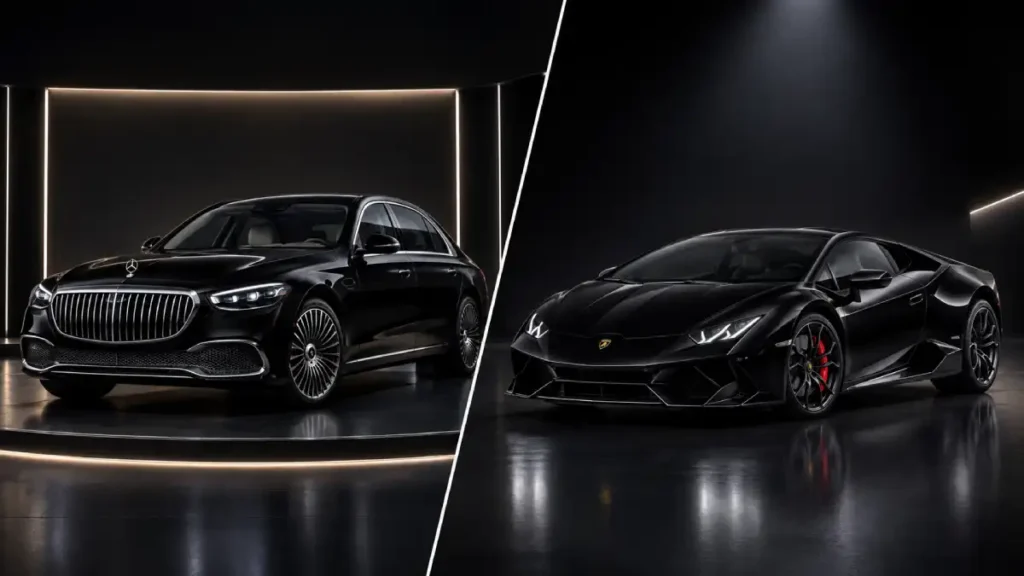
A static vehicle display is usually the stronger fit when a brand needs a luxury or exotic car as a visual centerpiece, photo backdrop, launch feature, or event installation. A self-drive exotic rental makes more sense when actual driving is the priority. For brand activations, the choice comes down to presentation versus driving access.
Where will the car sit? Can guests photograph it? Does it need branding nearby? Will it stay in one position? Does the venue permit vehicle displays indoors? Who coordinates load-in? And does anybody actually need to drive it?
Those questions separate a static vehicle display from a conventional exotic rental.
Curated Excellence itself makes a similar distinction. Its FAQ describes the business as a luxury event service built around vehicle staging and presentation rather than a standard rental model.
What Is a Static Vehicle Display?
A static vehicle display places a vehicle at an event, campaign, production, or activation primarily for presentation.
The car may act as:
- a hero installation;
- a branded photo backdrop;
- a product-launch centerpiece;
- an executive or VIP visual;
- part of a fashion campaign;
- an experiential marketing element;
- a multi-vehicle showcase.
The important point is that driving is not the main value. Instead, the vehicle earns its place by attracting attention and strengthening the visual story around the event.
That is why a luxury car corporate event Chicago planning guide focuses so heavily on footprint, load-in, guest circulation, staging, and venue logistics.
What Is an Exotic Car Rental?
A conventional exotic rental generally centers on temporary access to a vehicle, often with driving as the main reason for booking.
That changes the buying decision.
A renter may care about mileage, approved drivers, pickup and return timing, fuel, tolls, geographic restrictions, deposits, and other rental terms.
The Federal Trade Commission advises consumers to compare the total rental cost, not only an advertised base rate, and notes that factors such as mileage terms, fuel charges, toll programs, additional drivers, taxes, and return conditions can affect the final cost.
Those concerns matter when you want to drive.
For a brand activation where the car might remain parked for six hours beside a logo wall, they may be much less important.
Static Display vs Exotic Rental: Quick Comparison
| Factor | Static Vehicle Display | Exotic Car Rental |
| Main purpose | Presentation and visual impact | Driving access |
| Vehicle movement | Usually limited or controlled | Central to the experience |
| Brand integration | High priority | Depends on rental agreement |
| Photography | Often part of the plan | Usually secondary |
| Venue placement | Core consideration | Not usually the core service |
| Load-in planning | Important | Usually less event-focused |
| Guest interaction | Can be designed around display | Depends on provider rules |
| Mileage | Usually not the value driver | Often relevant |
| Best use | Activations, launches, campaigns, displays | Driving-focused use |
Neither model is automatically better. They simply solve different problems.
When a Static Car Display Works Better for Brand Activations
A static car display Chicago concept makes the most sense when the vehicle needs to communicate something visually.
Imagine a product launch where the car sits beside a new luxury product. Or a technology activation where a Cybertruck reinforces an innovation theme.
Or a corporate gala where an executive vehicle creates a premium arrival environment. In each case, moving the vehicle around Chicago adds little value. What matters is how it looks when guests arrive.
This is where planning shifts from rental questions to production questions:
Where will guests first see the vehicle? How much space does it need? Where will the photographer stand? Will signage block part of the silhouette? Will lighting reflect badly across the body panels?
Those are display questions.
Which Vehicle Fits Which Brand Style?
Curated Excellence’s current Black Label Collection includes a Ferrari 488 GTB, Cadillac Escalade IQ Sport, Tesla Cybertruck, Mercedes-AMG GLE 63 Coupe, and Mercedes-AMG E 53. The collection positions the vehicles with noticeably different visual identities-from exotic and iconic to futuristic, executive, refined, and sophisticated.
That means vehicle selection should follow the campaign concept.
| Brand Direction | Vehicle Style to Consider |
| Exotic / aspirational | Ferrari 488 GTB |
| Futuristic / disruptive | Tesla Cybertruck |
| Executive / commanding | Cadillac Escalade IQ Sport |
| Sport-luxury / refined | Mercedes-AMG GLE 63 Coupe |
| Sophisticated / polished | Mercedes-AMG E 53 |
For a more detailed creative comparison, the best luxury vehicle for a brand photoshoot guide explains how Ferrari, Cybertruck, Cadillac, and AMG models fit different brand identities.
The strongest choice is not necessarily the loudest car. It is the car that helps the campaign make sense in one glance.
Static Displays Give You More Control Over the Frame
Brand activations create content as well as in-person experiences.
A static vehicle can be positioned around a camera angle instead of asking the photographer to adapt to wherever the vehicle happens to stop.
That allows the production team to think deliberately about:
- three-quarter vehicle angle;
- wheel position;
- talent placement;
- background signage;
- branded flooring;
- lighting;
- reflections;
- logo visibility;
- negative space for campaign copy.
If campaign photography is a major objective, the exotic car photoshoot Chicago planning guide goes deeper into light, reflections, staging, shot lists, and location logistics.
When an Exotic Rental Is the Better Choice
A static display does not make sense if your campaign concept depends on actually driving the vehicle.
Maybe the content requires a road sequence, the client specifically wants a driving experience. Maybe the vehicle is needed as transportation rather than as a stationary installation.
In that situation, a rental provider whose agreement explicitly supports the required driving use may be the better fit.
The important part is not to book one service and assume it includes the other.
A display agreement should not automatically be treated as permission for client driving, and a conventional rental should not automatically be assumed to provide professional activation staging.
Read the actual terms.
Brand Activation Means Thinking Beyond the Car
A vehicle should not sit at an activation with no relationship to the surrounding campaign.
Think about the full scene. If the Cybertruck communicates futuristic design but the booth looks traditional and cluttered, the concept can feel disconnected.
If a Ferrari is meant to signal aspiration, give it enough space and clean lighting to work visually.
Curated Excellence currently includes corporate and brand experiences within its luxury car event services in Chicago. Its Corporate / Brand Experience includes brand and campaign photo support, executive arrival presentation, product launches and VIP events, and multiple-vehicle configurations.
That positioning is much closer to activation production than to a simple drive-away rental.
Indoor Static Vehicle Displays Need Extra Planning
Indoor displays can create excellent visual impact, but venue requirements need to be checked before the vehicle arrives.
McCormick Place provides a useful Chicago example. Its published fire-safety rules state that display vehicles with fuel tanks must have a locking or taped gas cap and no more than one-eighth tank of fuel. After positioning, battery cables must be disconnected, the engine cannot operate during show hours, and the vehicle generally cannot be moved before move-out without approval. Those are McCormick Place-specific rules, not universal Chicago rules.
Another venue may have different requirements for fuel, batteries, EVs, insurance, floor protection, security, loading, or staffing. The practical lesson is simple: send the vehicle details to the venue before activation day.
Plan the Display Footprint
Do not measure only the physical width and length of the car.
A usable display footprint may also need room for:
- guest circulation;
- barriers or stanchions;
- photographers;
- signage;
- lights;
- brand ambassadors;
- doors opening;
- product displays;
- safe load-in and removal.
A vehicle may technically fit into a space while still creating a terrible activation layout.
The best displays allow guests to recognize the car immediately, photograph it comfortably, and move through the event without creating a bottleneck.
Decide How Guests Will Interact With the Vehicle
Not every static display needs hands-on interaction. In some activations, the vehicle works best as a protected visual centerpiece. In others, guests may be invited to stand beside it for photographs.
Do not assume guests can sit inside, touch the car, open doors, or interact with controls. Those details should be agreed with the provider before the event.
Clear expectations also make it easier for brand ambassadors and venue staff to manage the activation consistently.
Static Display vs Rental for Social Content
Social content often makes static staging even more useful.
A vehicle can stay in a controlled position while the team captures:
- hero images;
- vertical video;
- creator content;
- executive portraits;
- guest photos;
- product close-ups;
- behind-the-scenes footage.
One strong setup can therefore create both an in-person activation and a bank of reusable campaign assets.
That is especially valuable when the location, lighting, and branding have been planned before guests arrive.
What to Send Before Booking a Brand Activation
Send enough information for the provider to understand the production-not just the vehicle request.
Include:
- event date;
- venue and full address;
- activation type;
- preferred vehicle;
- indoor or outdoor placement;
- load-in and load-out times;
- proposed vehicle position;
- available footprint;
- branding or signage;
- photography/video plan;
- guest-interaction expectations;
- venue restrictions;
- whether the vehicle ever needs to move;
- whether multiple vehicles are being considered.
This avoids the classic production conversation where everyone realizes two days before the event that nobody checked the loading entrance.
Which Option Fits Your Brand Activation?
Use this quick test:
If the vehicle stayed parked for the entire activation, would it still accomplish the campaign goal?
If the answer is yes, a static display is probably the stronger service model.
Planners evaluating a future static car display Chicago service should therefore think about the vehicle as part of the event environment-not simply as transportation.
When the vehicle, venue, activation concept, and timing are ready, you can reserve a luxury vehicle experience in Chicago and provide those details for availability and presentation coordination.
Frequently Asked Questions
Q1: What is a static vehicle display?
A static vehicle display places a vehicle at an event or production mainly for presentation, photography, branding, or guest experience rather than for customer driving.
Q2: Is a static vehicle display the same as an exotic car rental?
No. A rental usually centers on temporary vehicle use and driving. A static display centers on presentation, placement, staging, and the vehicle’s role within an event or campaign.
Q3: Which is better for a brand activation?
A static display is usually the stronger fit when the vehicle is serving as a visual centerpiece, photo backdrop, or branded installation. A driving-focused rental may be more appropriate when the campaign actually requires driving.
Q4: Can a luxury vehicle be displayed indoors in Chicago?
Potentially, but the venue determines the requirements. McCormick Place, for example, publishes specific rules for display vehicles involving fuel levels, batteries, engine operation, and vehicle movement.
Q5: Can guests sit inside a static display vehicle?
Do not assume so. Guest access, touching, door operation, and interior access should be agreed with the vehicle provider and venue before the event.
Q6: Which vehicle works best for a brand activation?
It depends on brand identity. Ferrari can communicate exotic aspiration, Cybertruck futuristic disruption, Cadillac executive presence, and AMG a more refined performance aesthetic.
Q7: What details should I send before booking?
Send the date, venue, preferred vehicle, activation concept, display footprint, load-in timing, photography requirements, branding needs, guest interaction plan, and venue restrictions.
Final Answer
For most brand activations, a static vehicle display is the better fit when the car needs to attract attention, support photography, reinforce brand identity, or become part of a physical installation.
A self-drive exotic rental is the better fit when driving the car is the main objective. The vehicle may be identical. The purpose is not.
For a successful activation, choose the service model around what the audience needs to see and experience, not simply around which exotic car you want on the booking form.