
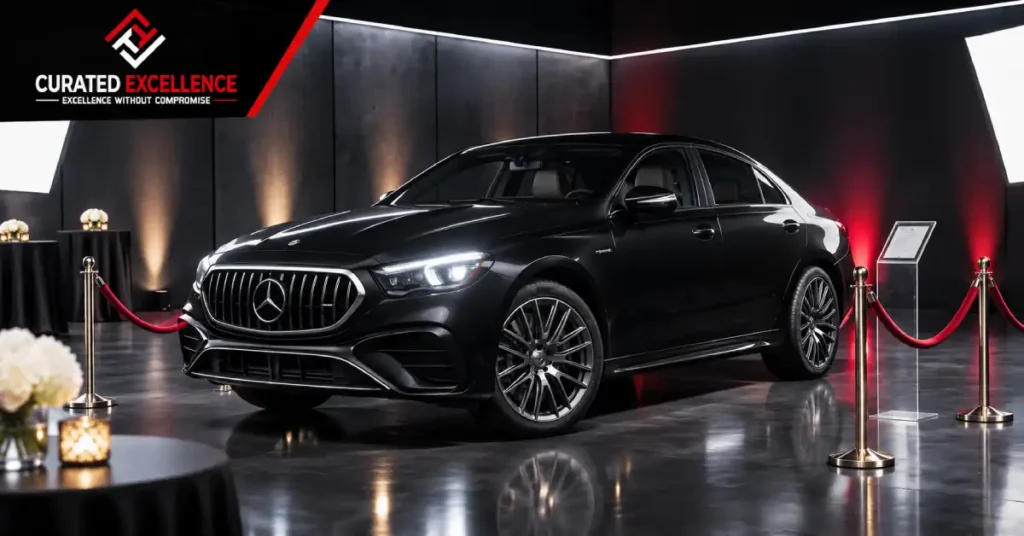
Indoor car display Chicago planning starts with venue approval, because a luxury vehicle must fit more than the room. Confirm the load-in route, door clearance, fire-safety rules, floor protection, display footprint, and guest circulation before finalizing the concept. The exact requirements depend on the property, event, and vehicle.
Indoor vehicle displays can make a gala, product launch, corporate event, private celebration, or brand activation feel more intentional. The challenge is that “the car fits inside” is not enough.
A successful display also needs an approved route into the building, safe placement, enough working space, and a setup that does not interfere with exits, fire equipment, guest flow, or venue operations.
Start With Venue Approval
The first question is not whether the vehicle physically fits. It is whether the venue will approve an indoor vehicle display in the proposed room.
Hotels, ballrooms, convention centers, galleries, and private venues can have very different requirements. Before confirming the concept, ask whether vehicles are permitted, whether a floor plan is required, whether fire-safety review applies, whether insurance documentation is needed, and which loading entrance must be used.
Get those answers before photography plans, signage, or brand assets are designed around the final vehicle position.
For a broader look at how display-based experiences differ from ordinary rentals, the static vehicle display vs exotic car rental comparison explains when a staged vehicle makes more sense than a driving-focused experience.
Indoor Car Display Chicago: Measure the Full Load-In Route
A vehicle may fit inside the ballroom but still be impossible to get through the building.
Measure the entire route from the exterior loading point to the final display position. Check loading entrances, service doors, corridors, ramps, turns, thresholds, and any temporary structures along the route.
| Access Check | Why It Matters |
| Entry door width | Mirrors and bodywork need safe clearance |
| Entry door height | Taller SUVs may require more vertical clearance |
| Tightest corridor | The narrowest point can determine whether access works |
| Turning space | A vehicle may clear a door but fail at the next turn |
| Ramp angle | Low vehicles can have clearance problems |
| Floor transition | Raised lips or steep changes can affect access |
| Final display area | The usable footprint must exceed the car itself |
According to McCormick Place facility guidance, equipment movement may be restricted to service corridors and designated doors. That is a useful example of why a Chicago venue may control not only where an exhibit sits, but how it enters and exits the building.
Check Fire-Safety Rules Before Choosing the Vehicle
Indoor vehicle requirements vary by venue, so never assume one rule applies everywhere.
McCormick Place provides a clear Chicago example. Its published fire-safety regulations state that a display vehicle with a fuel tank may contain no more than one-eighth of a tank, must have a locking or taped gas cap, and must have its battery cables disconnected after positioning. The engine cannot operate during show hours, and movement after positioning requires approval.
Those requirements should not automatically be applied to every hotel, ballroom, or private venue. Instead, use them as questions for the property managing your event.
For an electric vehicle, ask what battery, charging, ignition, key-control, or emergency procedures apply. Do not assume rules written for a fuel-powered vehicle translate directly to an EV.
Review the Floor Plan, Not Just the Car Dimensions
The real display footprint is larger than the vehicle.
Guests may stop for photos. Photographers need room to step back. Event staff may need access behind the display. Doors, signage, lighting, décor, and barriers can increase the space needed even further.
A Ferrari placed in an eight-foot-wide space is not really an eight-foot-wide display if a photographer needs another ten feet to frame the shot.
The practical lesson applies well beyond convention centers: the vehicle should fit the room without compromising how the room functions.
The Chicago corporate vehicle display guide covers the wider relationship between footprint, guest circulation, branding, staging, and event purpose.
Protect the Venue Floor
Finished stone, terrazzo, wood, carpet, and decorative flooring may need special handling.
Ask whether protective material is required beneath the tires or along the vehicle’s load-in route. Also confirm restrictions involving temporary flooring, mats, tape, dollies, or cleaning products.
The concern may be tire marks, dirt brought inside during load-in, surface pressure, fluids, or damage while maneuvering.
McCormick Place’s facility guidance includes specific controls for moving equipment across carpet and terrazzo, while its meeting-room guidance also addresses protective flooring for certain types of freight movement.
The venue manager should determine exactly what protection is appropriate for the room.
Decide Whether Guests Can Approach the Vehicle
An indoor car can be a visual centerpiece, photography backdrop, or interactive feature. Those are different layouts.
If guests only view the vehicle, the plan can focus on sightlines and presentation. And if guests will take photos beside it, the display needs more open space and a predictable circulation path.
If doors may open, the required footprint increases again.
Before floor-plan approval, confirm whether guests may touch or enter the vehicle, whether doors stay closed, whether barriers are needed, where a photographer will stand, and where guests will wait without blocking an aisle.
The multi-vehicle showcase staging guide becomes particularly useful when two or more cars are involved because spacing, sightlines, and guest movement become more complex.
Match the Vehicle to the Indoor Space
A Ferrari 488 GTB, Cadillac Escalade IQ, Tesla Cybertruck, Mercedes-AMG GLE 63 Coupe, and Mercedes-AMG E 53 do not occupy a room in the same way.
A lower Ferrari can create drama without much vertical mass. A full-size SUV may need more room around corners and doorways. A Cybertruck can create a very different architectural presence because of its shape.
The right choice depends on the room, access route, backdrop, guest count, and intended visual role.
Curated Excellence’s luxury event vehicles in Chicago can be compared before the venue reviews the proposed setup.
For larger executive-style vehicle staging, the Cadillac Escalade IQ event guide also explains how the SUV’s proportions affect event space and photography.
Plan Load-In Before Guests Arrive
An indoor display should generally be positioned before guest-facing activity begins.
A practical sequence is:
Loading access opens → vehicle enters → final position is set → required safety steps are completed → floor and display area are checked → lighting and signage are finalized → room becomes guest-ready.
Large venues can have formal schedules for docks, freight, contractors, and move-in. McCormick Place specifically advises exhibitors to coordinate with the show organizer and general contractor regarding move-in, show operation, and move-out.
Navy Pier also advises clients to work with the Event Manager on event-specific setup and fire-code requirements.
Keep the Vehicle Clear of Safety Infrastructure
The display should never block critical building functions.
Identify emergency exits, exit signs, fire extinguishers, hose cabinets, pull stations, sprinkler coverage, service corridors, accessible paths, and relevant security equipment before approving the final vehicle position.
McCormick Place specifically states that event elements should not block fire exits, strobes, facility signs, fire cabinets, security cameras, or sprinkler systems.
Design the display around the room’s safety requirements, not the other way around.
Use Indoor Displays for the Right Event Goal
An indoor luxury vehicle display works best when the car has a clear purpose.
For a product launch, it can anchor a branded photography area. At a gala, it can create a premium entrance feature. In corporate gathering, it can support executive portraits or sponsor content. Also private celebration, it can become a strong visual backdrop.
Chicago venues already accommodate vehicle-centered activations. Navy Pier’s brand activation information notes that previous activations have included vehicle displays, while Festival Hall provides large-scale exhibition and loading infrastructure.
The strongest concept still starts with the event goal. The vehicle should support the room, guest experience, and visual story rather than simply occupy available floor space.
Indoor Luxury Vehicle Display Checklist
| Area | Confirm Before Approval |
| Venue approval | Indoor vehicle permitted in the specific room |
| Vehicle | Exact make and model identified |
| Door clearance | Width and height measured |
| Load-in route | Dock, corridors, turns, ramps, and thresholds checked |
| Floor | Protection requirements confirmed |
| Fire safety | Fuel, battery, engine, and venue rules confirmed |
| Floor plan | Final vehicle position approved |
| Guest flow | Adequate circulation around the display |
| Doors | Opening policy and clearance confirmed |
| Barriers | Stanchions or ropes planned if necessary |
| Photography | Camera and guest-photo space available |
| Load-in | Approved arrival window and venue contact |
| Load-out | Removal route and timing confirmed |
| Backup | Alternate position available if access changes |
Frequently Asked Questions
Q1: Can you put a luxury car inside a Chicago event venue?
Often, yes, but it depends on the specific venue and room. The venue should approve the vehicle, load-in route, final position, and applicable safety requirements before the event.
Q2: Does an indoor display vehicle need an empty fuel tank?
Not necessarily. Requirements vary by property. McCormick Place, for example, permits no more than one-eighth of a tank for display vehicles with fuel tanks and applies additional gas-cap and battery requirements.
Q3: Can an electric luxury vehicle be displayed indoors?
Potentially, yes. EV requirements can differ from combustion-vehicle rules, so ask the venue about battery state, charging, ignition control, emergency procedures, and any event-specific restrictions.
Q4: How much space should be left around the vehicle?
There is no universal clearance for every event. Allow enough room for guest circulation, photography, open doors if applicable, barriers, signage, and required accessible or emergency paths.
Q5: Do I need floor protection under the car?
The venue decides. Ask about tire protection, protective mats, finished-floor requirements, and the full load-in route before the vehicle arrives.
Q6: Can guests sit inside the vehicle during the event?
Do not assume so. Guest access should be agreed with both the vehicle provider and venue before the event.
Make Indoor Vehicle Staging Part of the Event Plan
An indoor car display Chicago event can create a memorable centerpiece, but the best result starts with access and approval rather than decoration.
Confirm the vehicle, room, loading route, fire-safety requirements, floor protection, display footprint, guest flow, and move-out plan before event day. Once those details are settled, lighting, branding, photography, and presentation can be built around a setup that works.
Planning an indoor luxury vehicle display in Chicago? Curated Excellence can help coordinate the vehicle presentation, staging concept, event timing, and venue-facing details around your event plan.